

Tools for Thinking
Avoid unreasoned "truths."
Introduction
Read an online post or watch an online video, and you may find yourself asking, “How can they be so certain about the claims they make?” and “Where’s the empirical evidence that supports that argument?”
I argue that “facts” and “empirical data” do not provide the best place to start. If you apply sound reasoning to these questions first, you will save a lot of time and effort searching for evidence that may not exist. If the claim does not hold up to sound reasoning, ask for the presenter’s assumptions or move on.
In my newsletters, I rely on a few “Tools of Thinking” to determine whether a claim holds up to reasoning. In this publication, I provide brief descriptions of four primary tools I use to evaluate presentations I hear or read.
Ø Austrian Methodology
Ø General Semantics
Ø Deductive Logic
Ø Systems Thinking
I will keep my introduction brief, as I only want to call your attention to these “tools.”
Austrian Methodology
The Austrian Methodology applies the principles, theories, and values espoused by the Austrian school of economics. Although many people refer to Austrian economics, I prefer to use the term Austrian methodology. Members of the Austrian school studied economic behavior and developed their principles, theories, and values based on that observation.
Numerous authors have described the Austrian Methodology in books and articles. I will not attempt in any way to duplicate that writing. I want to identify the primary distinction between the Austrian school and other schools of economics. The Austrians placed significant importance on the role of the individual. They developed the subjective theory of value, which relies on an individual’s preferences. Only individuals can assign and measure value. Outside observers can only estimate the values individuals assign based on market transactions. Observers can say with confidence that each party values what they got more than what they gave up.
The subjective theory of value provides the primary distinction between the Austrian Methodology and other schools of economics.
General Semantics
General Semantics helps us understand the abstract nature of markets.
Alfred Korzybski developed what we now call General Semantics in his tome, Science and Sanity. In that book, he theorized that the limitations of human senses require us to live in a world of ever-increasing abstraction. For example, we surround ourselves with electromagnetic waves from radios, cell phones, and broadcast media, yet we cannot sense the waves we know exist. We have abstracted a slice of the electromagnetic spectrum only to see what we find meaningful.
A diagram referred to as the “Structural Differential” (See the image below) best depicts these ideas.
Structural Differential
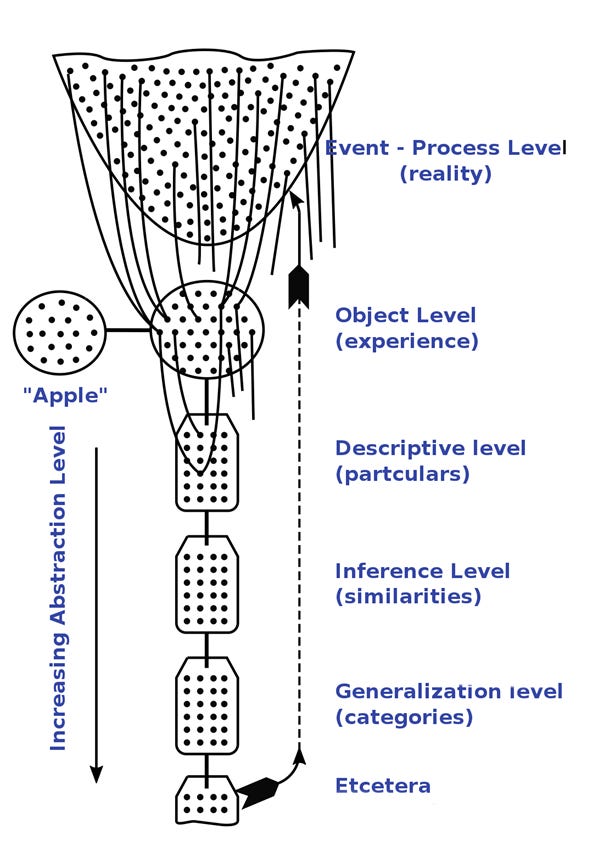
Abstraction (higher levels of inference) can help us understand markets, but abstraction can separate our thinking from reality. Only by connecting the abstract thinking with reality can we hope to maintain sanity individually and collectively.
I would argue that economists have taken levels of abstraction to the point of creating mass insanity. Economic measures such as GDP, CPI, and unemployment rates, among others, give misleading impressions of “the economy.” Consistent with Austrian Methodology, the only transactions that matter consist of those between individuals.
Deductive Logic
In the deductive argument, all information necessary to the conclusion exists in the premises themselves. The premises in a deductive argument can be derived either from inductive logic or pure reason, i.e., a priori.
Deductive arguments always follow the same pattern:
Premises + Argument = Conclusion
Deductive Arguments Come in Four Combinations
First
1. If the Premises Are: True
2. And the Argument Is: Valid
3. Then the Proposition Is: Sound
Second
1. If the Premises Are: True
2. And the Argument Is: Invalid
3. Then the Proposition Is: Unsound
Third
1. If the Premises Are: False
2. And the Argument Is: Valid
3. Then the Proposition Is: Unsound
Fourth
1. If the Premises Are: False
2. And the Argument Is: Invalid
3. Then the Proposition Is: Unsound
Only one combination of premises and argument gives a sound logical argument.
A person should always keep two important factors in mind when considering logical arguments:
First, beginning with a true premise does not always lead to a sound proposition.
Second, a sound conclusion does not by itself provide proof of either a true premise or a sound argument. The party making the argument can simply be lucky in arriving at a sound proposition.
If you listen carefully to the conclusions that people represent as sound, many rest on either false premises or invalid arguments. Listen carefully to what people tell you about economics. Get them to give you evidence of the truth of their premises and examine carefully the validity of their argument. If they have not combined true premises with valid arguments, you have every right to doubt the soundness of their conclusion.
Systems Thinking
It seems that many (if not most) people cannot understand the interconnections in the systems in which they live and do not appreciate the information feedbacks that influence the long-term behavior of their systems.
In this category, I will develop clear, concise definitions and examples of systems. In the end, only through systems thinking can we hope to understand how the complex systems we call “markets” function.
A System is an entity which maintains its existence through the mutual interaction of its parts.
The late Austrian Biologist
Ludwig von Bertalanffy
One of the most widely accepted definitions of a system comes, appropriately, from a biologist. Deep understanding of living entities requires seeing them as systems. The interaction takes on more importance than the parts themselves.
Keep this in mind. An economic system has all the open, self-referencing, self-organizing characteristics of a living system.
Systems Principles
ü Openness
ü Purposefulness
ü Multidimentional
ü Emergent Property
ü Counter Intuitive
Conclusion
In college, I had an economics professor who would deduct one point from a student’s grade for each spelling or grammatical error he found. When he got to “F,” he quit reading. I quickly learned to spend less time writing and more time thinking.
I don’t want to waste my time attempting to “fact-check” every claim I hear or read. I would rather spend my time examining information that passes a preliminary test of reason. This practice fits my purpose in publishing this newsletter. I have little interest in telling you what to think. I want to help you test the noise you get from different media.
I suggest that when you encounter statements in the media, use reason to test what you read or hear. When you encounter a second inconsistency in your reasoning, stop and move on to something else. Thinking about what you read will save you hours in the long run.